Threat model
What WebFrost protects, who can attack it through which component, the controls in place and the risks that remain open.
Revised 2026-11-21. Scope: @webfrost/core, @webfrost/cli, @webfrost/server, @webfrost/sdk, @webfrost/ui
This document maps what WebFrost protects, who can attack it and through which component, and which risks remain open. Configuration details for each control are in Security.
System overview
WebFrost is single-tenant and self-hosted. One operator runs the server; one admin account (plus API keys) uses it. Users submit URLs; the server fetches them with an HTTP client and a headless Chromium, and stores the results as files plus a database (SQLite by default).
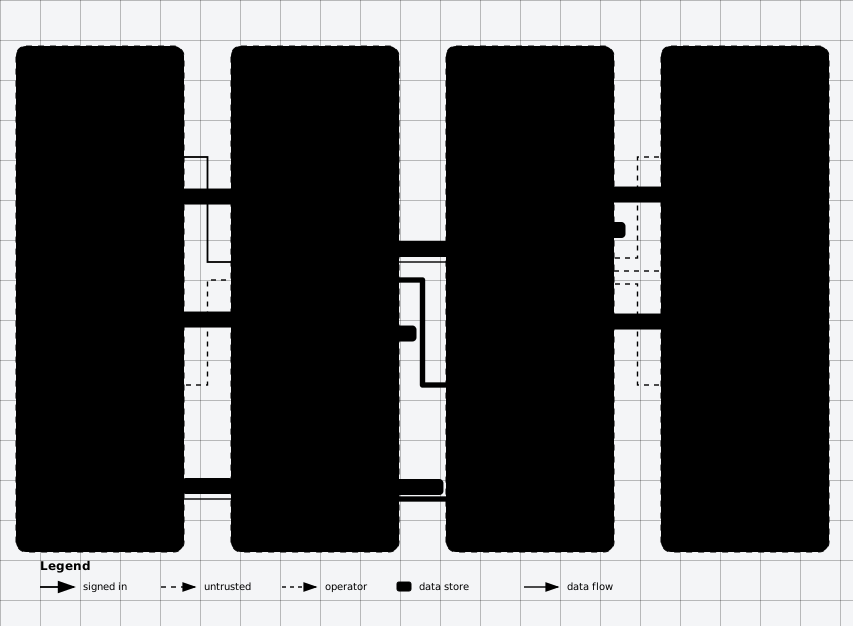
The CLI drives the same core library directly against the data directory, without the HTTP layer.
Assets
| Asset | Why it matters |
|---|---|
| The archive (files + database) | The product. Loss or tampering defeats the purpose. |
| Admin password hash, session rows, API key hashes | Grant full control of the instance. |
SESSION_SECRET | Signs session cookies. |
| The server's network position | It can reach hosts that outside users cannot (intranet, cloud metadata). |
| Host resources (CPU, memory, disk) | Each pipeline launches a browser and writes files. |
Trust boundaries
| Actor / input | Trust |
|---|---|
| Operator (shell access, environment, data directory) | Fully trusted |
| Authenticated admin / API key holder | Trusted to manage the archive. Not trusted to reach the internal network through it. |
| Unauthenticated network client | Untrusted. Can reach /health, the static UI, login and (before first run) setup. |
| Submitted URLs, feeds and import files | Untrusted input |
| Fetched pages and every resource they load | Untrusted and potentially hostile |
| DNS answers | Untrusted |
| Reverse proxy | Trusted only if WEBFROST_TRUST_PROXY=true |
Attack surface and controls
1. Authentication and sessions
| Threat | Control | Status |
|---|---|---|
| Unauthenticated API access | All /api/v1/* routes require a session or API key | Mitigated |
| Anonymous visitor changing the archive when public read is on | WEBFROST_PUBLIC_READ admits only GETs on an explicit allowlist of read routes; storage paths and raw extractor errors (which can name internal hosts and paths) are withheld from anonymous responses; list pages capped at 200 | Mitigated |
| Operator enables public read on an archive holding private captures | None — the whole archive becomes readable | Operator responsibility |
| Password brute force | 10 attempts/min per client; bcrypt; uniform timing for unknown users | Mitigated |
Rate-limit evasion with a forged X-Forwarded-For | Header ignored unless WEBFROST_TRUST_PROXY=true; behind a proxy the right-most entry (minus WEBFROST_TRUSTED_PROXY_HOPS) is used, never the client-chosen left-most; IPv6 bucketed per /64 | Mitigated |
| Stolen session cookie | HttpOnly/SameSite=Strict/Secure; server-side sessions revoked on logout, on re-login over the same cookie and on password change | Mitigated |
| Oversized bodies (huge passwords for bcrypt, giant imports) | Length limits on every string field; imports capped by size and URL count (413); request body cap | Mitigated |
| Forged cookie | HMAC-SHA256 with SESSION_SECRET, constant-time compare, must match a session row | Mitigated |
| Leaked API key | Stored hashed; revocable; optional expiry | Mitigated |
| First-run takeover: whoever reaches a fresh instance first creates the admin | Setup only works while no admin exists; WEBFROST_SETUP_TOKEN makes it require a secret; a warning is logged at startup while setup is open and unprotected | Mitigated with WEBFROST_SETUP_TOKEN; otherwise finish setup before exposing the port |
| CSRF, including from a sibling subdomain (same site) | Cookie-authenticated writes need Sec-Fetch-Site: same-origin/none, or a matching Origin; JSON-only bodies (415 otherwise); SameSite=Strict; form-action 'self' | Mitigated |
Everything above bypassed by AUTH_DISABLED=true | Warning logged at startup; binds to 127.0.0.1 unless HOST is set | Operator responsibility |
2. URL submission — snapshots, imports, schedules
| Threat | Control | Status |
|---|---|---|
| SSRF to loopback / private / link-local / metadata addresses | safeFetch resolves and rejects on every hop; IPv4-mapped and NAT64 forms covered | Mitigated |
| SSRF through redirects | Redirects followed manually and re-validated (max 5) | Mitigated |
Non-HTTP schemes (file:, ftp:) | Rejected at the route, the CLI and in safeFetch | Mitigated |
| DNS rebinding between check and connect | None at application level | Open — use network egress controls |
| Memory exhaustion via huge responses | 50 MB cap, streamed | Mitigated |
| Slow-loris upstream holding a worker | 30 s fetch timeout | Mitigated |
| Flooding the pipeline | 60 creations/min per client; WEBFROST_CONCURRENCY bounds running pipelines | Mitigated |
| Unbounded queue from one very large import | None — queued jobs are rows plus a small in-memory entry each | Accepted |
| Hammering a third-party site | Per-host gap between archives (WEBFROST_DOMAIN_DELAY_MS) | Mitigated |
3. Headless Chromium
The page being archived controls what the browser requests.
| Threat | Control | Status |
|---|---|---|
Page embeds an internal URL (iframe, image, fetch, WebSocket) and it is captured in the screenshot/PDF/DOM | Every browser request is checked; blocked hosts are aborted | Mitigated |
| Subresource or navigation redirects to an internal host | Detected; browser extractors are skipped for the snapshot so nothing is captured | Mitigated for disclosure; the request itself is still sent (blind SSRF, open) |
| Script waits until after load, then loads an internal URL | All requests are checked, and once the network settles (WEBFROST_SETTLE_MS) all further requests are refused, before capture | Mitigated |
| Service worker making unchecked requests | Service workers blocked | Mitigated |
| Page stalls or loops forever | 30 s navigation timeout; 60 s per extractor; browser closed afterwards | Mitigated |
| Renderer exploit | Chromium runs without its own sandbox inside the container; the container is the boundary | Open — keep the image updated, do not add capabilities |
4. Media extraction (yt-dlp)
| Threat | Control | Status |
|---|---|---|
| Argument injection through the URL | URL passed as a single argv element, no shell | Mitigated |
| Runaway download | 500 MB size cap; process killed after 10 min | Mitigated |
| Pipeline waiting forever on a finished subprocess (lost exit notification, pipe held open) | Output collection gives up 3 s after the process exits or its pipes close | Mitigated |
| yt-dlp following redirects to internal hosts | Only the initial URL is validated | Open |
5. Serving archived content
| Threat | Control | Status |
|---|---|---|
| Stored XSS from archived HTML | Downloads are Content-Disposition: attachment (with S3, signed into the presigned URL together with the content type, so HTML never renders on the bucket's origin); the in-app preview is served with CSP: sandbox (opaque origin, no scripts, no network) inside <iframe sandbox="">; strict CSP on the app itself | Mitigated |
| Archived page phoning home when previewed | Preview policy allows only inline styles and data: URIs | Mitigated |
| HTML injection through search snippets | Server escapes archived text; UI renders snippets as text nodes | Mitigated |
| Path traversal via a stored file reference | Reference normalised and checked against the storage root / S3 prefix | Mitigated |
| Unknown extractor name | Allowlist | Mitigated |
| Clickjacking | frame-ancestors 'none', X-Frame-Options: DENY | Mitigated |
6. Data at rest
| Threat | Control | Status |
|---|---|---|
| SQL injection | Bound parameters everywhere | Mitigated |
| Concurrent writers corrupting or losing writes | WAL mode, busy_timeout, one connection per job | Mitigated |
| Snapshots lost in limbo after a crash | Jobs are leased by heartbeat; a pending job whose lease expired is re-queued (checked at startup and every minute), up to 3 times | Mitigated |
| Two processes on one archive (server + CLI worker) stealing each other's jobs | Only jobs with an expired lease are adopted, inside an immediate transaction | Mitigated |
| First-run setup raced by two requests | Admin row inserted only if none exists, atomically | Mitigated |
| Local user reading the archive | None — plain files | Operator responsibility (file permissions, disk encryption) |
| S3 credentials in the environment | None | Operator responsibility |
7. CLI
The CLI runs with the operator's own privileges against a local directory, so it is trusted input by definition. It still refuses non-HTTP(S) URLs and applies the same SSRF guard as the server.
Open risks, ranked
| # | Risk | Severity | What to do today |
|---|---|---|---|
| 1 | DNS rebinding past the SSRF guard | Medium | Block egress to internal ranges at the network layer |
| 2 | Blind SSRF through browser redirect hops and yt-dlp | Medium | Same as above |
| 3 | Chromium without its own sandbox | Medium | Keep the image current; treat the container as the sandbox |
| 4 | First-run setup race | Low | Set WEBFROST_SETUP_TOKEN, or complete setup before exposing the port |
| 5 | Rate-limit state is per process and in memory | Low | Single-instance deployments only; limits reset on restart |
Items 1–2 would be closed by routing all outbound traffic through a filtering egress proxy that pins the validated IP; that is tracked in the roadmap.
Out of scope
- Multi-tenant isolation. There is one admin; every credential sees the whole archive.
- TLS. Terminate it at a reverse proxy.
- Authenticity of archived content. WebFrost records what the server returned at capture time; it does not sign or notarise it.